
⚡ The Short Version (For Skimmers):
- Start with the problem you’re facing right now.
- Check that other people search for it (Pinterest test).
- Check the competition for content holes.
- Check the money trail.
- List 30 post ideas in 20 minutes, then find your angle.
Pass all five and you’ve got a niche. The details are below, with a Do this today action at each step.
My first niche was a disaster. Both of them, actually. 😅
Before Dollar Smart Guides existed, I tried CPA marketing with Instagram and Facebook ads, and lost about $500 learning it wasn’t for me. Then I started a blog about trending stories, because trends felt like the fast lane. Nothing resonated. Not with readers, and honestly, not with ME. I wrote about whatever was hot that week and felt nothing for any of it.
The niche that finally worked wasn’t found in a keyword tool. It found ME, in my own life.
I come from a middle-class family. I was in debt. I wanted out of my 9-to-5 so badly I could taste it, and I spent my evenings researching how to make money, save money, and build a business of my own. When I looked around the forums, I saw crowds of people struggling with my exact problems: getting rid of debt, making extra money, saving, investing, wanting full financial freedom.
My problem was their problem. So I started solving it out loud, and Dollar Smart Guides was born.
Since then, women have asked me “what should I blog about?” more times than I can count. I don’t answer with guesswork. I use the same thinking that worked for me, every time, so I turned it into a system: 5 steps to a niche that fits your life, has an audience waiting, and can make you money.
Here’s the part nobody believes until they live it: once your niche is right, you stop doubting. I have NEVER doubted mine, because my audience is real, my problem was real, and teaching women to reach financial freedom makes me genuinely happy. That’s what the right niche feels like. Let’s find yours. 🙂
📌 PIN (OR BOOKMARK) THIS PAGE. You’ll want this 5-step niche system in front of you while you decide.
📋 In This Guide
+
- Why Niching Down Matters (More Than You Think)
- Know Yourself First: The 5-Minute Self-Audit
- Step 1: Start With the Problem You’re Facing Right Now
- Step 2: Check That Other People Are Searching (Pinterest Test)
- Step 3: Check the Competition for Content Holes
- Step 4: Check the Money
- Step 5: The 30-Post Test (+ Find Your Angle)
- Can ANY Niche Be Profitable?
- Niche Ideas: Start From the 5 Money Needs
- “But I Love 2–3 Topics!” — Read This
- Write Your Niche Statement
Why Niching Down Matters (More Than You Think)
“Blog about everything” sounds like freedom. It’s a trap.
Think of a diner with a 40-page menu next to a tiny ramen shop with a line out the door. Nobody can say what the diner is FOR. Everyone can tell you what the ramen shop is for. Your blog works the same way: if readers can’t say what you’re for, they can’t follow you, trust you as THE person for their problem, or buy from you with confidence. A niche fixes all of that at once:
- Money comes quicker. Brands and affiliate programs pay for specific audiences, not general ones.
- Content ideas get easier. Your topic always tells you what to write next, so no more blank page.
- Marketing gets simpler. Pinterest and Google both understand a focused blog faster.
- You become the expert. Expert identity is what turns a hobby blog into a business.
My own proof: “Personal finance” is one of the most crowded topics on the internet. I didn’t blog about money for everybody. I niched down to women, especially women at home who want to earn from home and support their families. That focus is why Dollar Smart Guides works. Same crowded ocean, but I chose my corner of it and owned it. 🌊
There’s a second reason, and I feel it in my bones: our minds are focus machines, and at any one time we can only truly focus on one thing. A focused niche isn’t just good marketing. It’s how your brain actually wins.
Know Yourself First: The 5-Minute Self-Audit
Before any tools or research, we start with YOU. Grab a notebook (or the free workbook at the end of this post) and answer these honestly:
- What are you good at? Skills from jobs, hobbies, life. All of it counts.
- What problems have you overcome? Debt, weight, a messy house, a hard season you survived.
- What do friends ask YOUR advice about? This one is gold. People are already telling you your expertise.
- What could you talk about for hours without getting bored?
- What problem are you facing RIGHT NOW?
The fifth question matters most, and it’s where my system begins. Most blogging advice says start with your passion or a keyword tool. I’m going to tell you something different, something I learned by getting it wrong first.
Do this today: Set a 5-minute timer and answer all five questions. Circle the answer to #5.
Step 1: Start With the Problem You’re Facing Right Now
When women ask me “What should I blog about?” I never answer with a list. I ask one question first:
“Which problem are you facing right now?”
Here’s what I know for sure: if you can solve that problem for yourself, you can help other people get rid of it too, and that is the perfect niche for you.
A problem you’re living right now gives you three superpowers no keyword tool can:
- Authenticity. You’re not performing expertise, you’re documenting a real journey. Readers feel the difference in every sentence.
- Endless content. Every small win, mistake, and discovery on your way out of the problem is a blog post.
- Focus. When your blog and your LIFE pull in the same direction, everything moves faster.
To be fair, there are two types of people in this industry. Business-minded bloggers can take any topic and run it like a business. Problem-solvers live a problem, beat it, and teach the way out. Both can succeed. But watch what happens when the two get mixed up. Say you’re struggling with money right now, but you launch a blog about relationships because someone said it makes money. Your mind is now split between your actual problem and your blog topic. In my experience, the success rate of that divided approach is about 50/50. Why gamble, when your own problem gives you focus AND authenticity in one package? 🎲
My niche chose me this way. I was in debt, I wanted out of my 9-to-5, and I was researching how to make money and build something of my own. My problem WAS the niche. I just had to notice it.
Do this today: Finish this sentence: “The problem I’m trying to solve right now is ______.” That’s your niche seed.
Step 2: Check That Other People Are Searching for It (The Pinterest Test)
A problem only you have is a diary, not a blog. So now we check whether other people are actively looking for the solution.
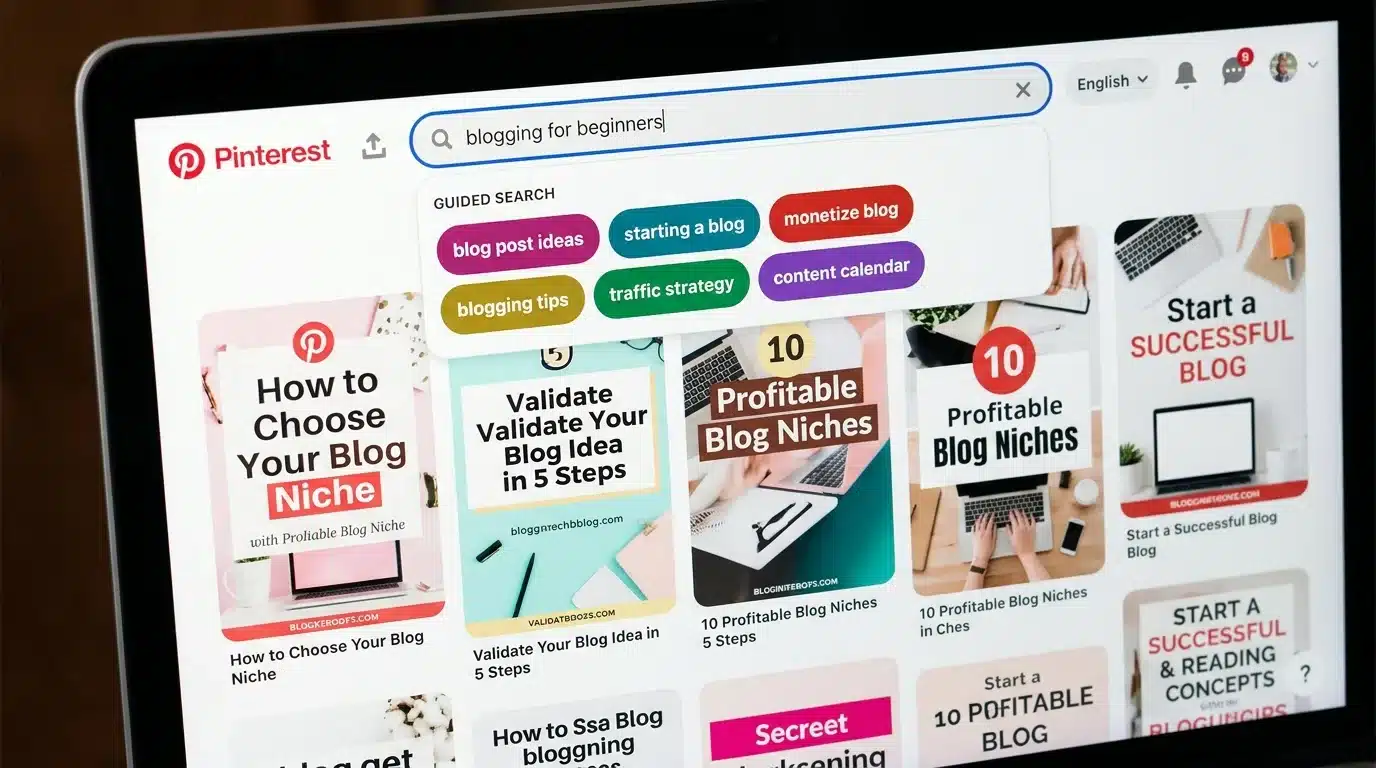
Most guides send you to complicated keyword tools here. I send you to Pinterest, because that’s where your future readers actually are, searching in their own words.
Your 10-Minute Validation
- Search your topic on Pinterest. Does an interest page exist? Are there guided search terms underneath (Pinterest literally telling you what people search)?
- Look at the pins. Are blogs actively publishing on this problem? Are pins getting saved?
- Read the words people use. The exact phrases on top pins are the exact language of your audience. They’re gold for your future post titles.
This is the modern version of what I did before my blog existed. I researched forums and found crowds of people struggling with the same problems I had, publicly asking for help. That’s demand. When I saw it, my doubt ended. Run the same check on Pinterest and let the crowd tell you the truth.
💡 Finding other blogs in your niche is NOT a stop sign. It’s proof the audience exists.
Do this today: Search your Step 1 problem on Pinterest. Copy the five top guided-search phrases into your notebook.
Step 3: Check the Competition for Content Holes 🕳️
Competition is only scary if you plan to copy. We’re hunting for the GAPS.
Study the top blogs and pins in your niche and look for:
- Thin posts. A 600-word article ranking for a big topic? Write the in-depth, actually helpful version and win.
- Missing formats. Everyone writes articles, but nobody makes the printable, the checklist, or the step-by-step with real numbers? That hole is yours. (If you’re wondering how to create those, our guide on selling printables online shows the exact process.)
- Unanswered questions. Read the COMMENTS on competitor posts. Every “but what about…?” is a post idea your audience is begging for.
When I looked at personal finance, the hole I saw was a voice: so much money advice was written by men, or by people who’d forgotten what it feels like to be scared at the grocery store checkout. Women at home needed one of their own, telling the truth. That gap became my whole brand. Your niche has a gap like that. Find it.
Do this today: Open the top three blog posts for your topic. Write down one thing each one leaves out.
Step 4: Check the Money 💰
A profitable niche isn’t just popular. It has a visible money trail. Before you commit, look at 3–5 blogs in your niche and ask:
- Affiliate products? Tools, courses, or products they earn commissions on.
- Their own products? Printables, ebooks, courses.
- Ads? A sign of serious traffic.
- Services? Coaching, freelancing, consulting.
If you see blogs earning in a niche, the money path is proven. If NOBODY in the niche seems to earn anything, that’s important data too. Proceed with your eyes open.
💡 A quick compass: the most profitable niches serve a basic human need: health, wealth, happiness, time, or love. My niche (wealth) sits squarely in one. If your problem helps people get healthier, wealthier, happier, save time, or love better, there’s a buyer on the other side.
Want to see exactly what monetization methods look like in practice? I break down all five income streams (affiliate, ads, products, services, and sponsored posts) in my guide on how to start a blog and make money.
Do this today: Tally the money trail for 3 blogs in a quick list (affiliate / products / ads / services). Three or more checkmarks on a blog means the path is proven.
Step 5: The 30-Post Test (+ Find Your Angle)
Final gate. Set a timer for 20 minutes and list 30 blog post ideas inside your niche.
- Reached 30 easily? Your niche has legs. You’ll never run dry.
- Stuck at 7 and scraping? The niche is too narrow, or honestly, it’s not your problem to solve. Go back to Step 1.
Then Find Your Angle
An angle is your topic × audience × story.
| Level | Example |
|---|---|
| Topic | Meal planning |
| Angle | Meal planning for night-shift nurses who are tired of takeout |
| Mine | Personal finance × women at home building income × a woman who climbed from debt to financial freedom herself and teaches the way |
One last check: is it evergreen? Will people have this problem in 3 years? Debt, health, feeding a family, and building income don’t expire. A niche built on this month’s viral trend does. (Ask me how I know. You met my trending-stories blog at the top of this post. 😅)
Passed all 5 steps? Congratulations: you don’t have a “blog idea.” You have a niche. Now let’s clear the remaining doubts.
Do this today: Run the 20-minute timer, write your 30 ideas, and count them.
Can ANY Niche Be Profitable? (And When a Niche Honestly Can’t Work)
Here’s the truth in both directions.
The encouraging truth: blogs rarely fail because of the niche. They fail because of no traffic and no focus. A “boring” niche with a real problem, real demand, and a blogger who keeps showing up beats a “hot” niche abandoned in month three. Almost any problem-anchored niche can work.
The honest warnings. A niche is truly in trouble when:
- Nobody is searching for it. Step 2 comes back empty. That’s a diary topic, not a blog topic.
- Nobody anywhere is earning in it. Step 4 shows zero money trail.
- The problem expires fast. A niche built on one season of your life with no future (be careful with baby-stage niches if your baby is already a toddler!).
- You can’t write 30 posts. Step 5 tells you the truth if you listen.
Notice what I didn’t list: “too much competition.” That’s never on the failure list.
Niche Ideas: Start From the 5 Money Needs
Still circling? Use the money-needs compass to spark your problem:
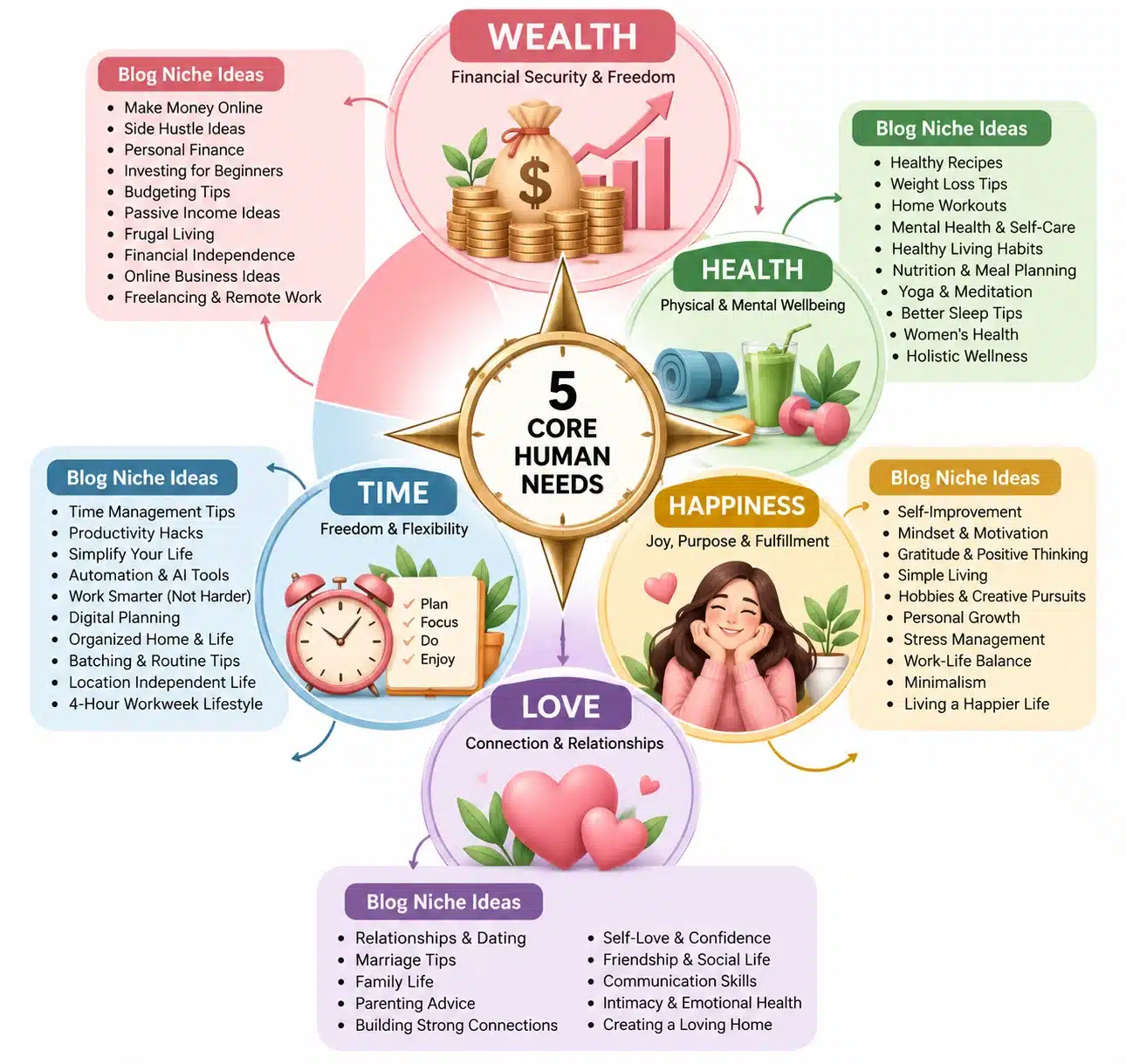
| Need | Niche Ideas |
|---|---|
| 💰 Wealth | Budgeting for beginners, paying off debt, side hustles for women, saving challenges |
| 💪 Health | At-home fitness for busy women, simple healthy meals, mental health and calm living |
| 😊 Happiness | Home organization, simple living, self-care that isn’t expensive |
| ⏰ Time | Meal planning, quick cleaning systems, productivity for moms |
| ❤️ Love | Date ideas on a budget, keeping marriage strong in busy seasons, family activities |
Notice that every example is a PROBLEM wearing a category’s clothes. Pick the need, then find YOUR problem inside it.
Want the full list? I put together 25 Profitable Blog Niche Ideas for Women, with the exact audience angle for each one.
Do this today: Pick the need your Step 1 problem touches, and circle one idea in its row.
“But I Love 2–3 Topics!” — Read This Before You Choose
I know. You cook AND craft AND care about money, and picking one feels like leaving your other loves at the door. 🚪
Here’s my answer, and the ORDER matters. Plenty of successful bloggers write about 2–3 topics and do very well. It’s possible! But at FIRST, focus on one topic. Win it. Build your expert identity until you’re THE person readers name for that one thing. THEN, from that strong base, talk about other topics and carry your loyal audience with you.
Sequence is everything. Starting broad makes you invisible. Starting focused makes you known. Known bloggers can broaden. Invisible ones just stay invisible. Your other topics will wait for you. They’ll still be there when your expert identity opens the door for them.
Write Your Niche Statement
Last exercise, and it makes everything real. Fill in this sentence:
“I help ______________ to ______________.”
- Mine: “I help women at home take control of their money and build income from home, so their families can become debt-free and financially free.”
- Maybe yours: “I help busy moms to feed their families well on a small budget.”
- Or: “I help beginners to organize their homes without buying more stuff.”
Say it out loud. If it makes you nod and smile, that’s your niche introducing itself. 💛
🎁 Grab the Free Niche Workbook
It walks you through the self-audit, all 5 steps, your 30-post brainstorm grid, and your niche statement. Print it, work through it this weekend, and be DONE deciding.
Do this today: Write your statement in the Notes app on your phone. Edit it later. Don’t skip it now.
Final Thoughts ❤️
People sometimes ask whether I’d choose a different niche today, maybe for a second blog. I tell them the truth:
I am happy with my niche. 💛
That’s not luck. It’s what happens when your niche is built on a problem you actually lived, an audience you actually found, and people you actually love helping. The 5 steps in this post aren’t theory. They’re the road I walked, including the two wrong turns at the beginning.
So here’s your move: stop collecting niche lists. Go back to Step 1 and answer the only question that matters: which problem are you facing right now? Solve it. Teach it. Let your focus machine do the rest.
Your niche is closer than you think. It’s probably sitting in your own life, waiting for you to notice it.
Enjoyed this post? Pin the image below, and follow me on Pinterest over here! 🙂
💻 Already picked your niche? Your next step is setting up the blog itself. My complete guide How to Start a Blog and Make Money walks you through it, step by step.
📖 Keep Reading