
I used to think coloring was a kids-only hobby. Then I found people making hundreds — sometimes thousands — of dollars a month from it.
No fine arts degree required. No expensive equipment either. Some people sell digital downloads.
Others turn illustration, teaching, or content into full-time businesses. If you enjoy coloring, drawing, or working with color in any form, there are legitimate ways to turn those skills into income.
Here are 8 ways to get paid to color.
The list starts with the simplest, lowest-barrier options and moves toward the highest-income, skill-based opportunities. (Looking for more creative income ideas? Check out our creative side hustles guide here).
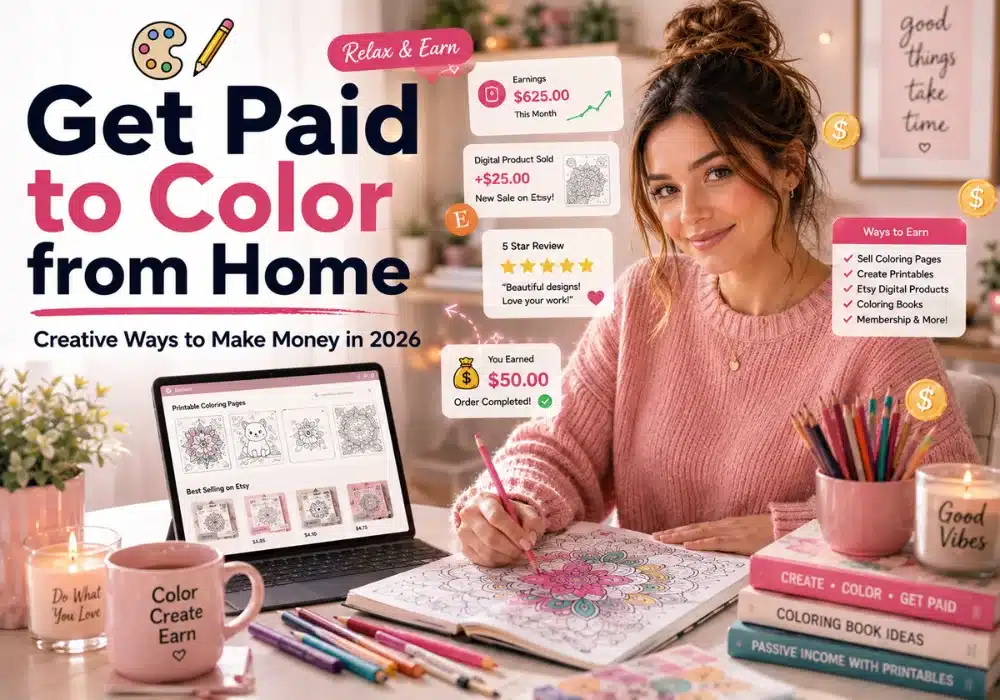
Categories
Use these categories to jump straight to the income style that fits you best.
- Sell Your Creative Work — passive income from digital and physical products
- Earn With Apps and Platforms — casual side cash from your phone
- Offer Services to Others — freelance income using your creative skills
- Teach What You Know — course and content income from sharing your knowledge
1. Sell Coloring Pages and Printables on Etsy
Category: Sell Your Creative Work
Etsy has 86.5 million active buyers — and millions of them search for printable coloring pages every day.
Printable coloring pages sell because buyers want instant downloads they can use immediately — no shipping, no store trip.
You create the file once. It’s not passive income overnight — but once your listings rank, older designs can sell for months with little extra work.
Free tools like Canva or Procreate are more than enough to start. Design your pages, export as PDFs, list on Etsy for $0.20 per listing, and you’re in business.
(Read our guide on selling digital products on Etsy to learn more).
To stand out, pick a niche. Christmas coloring packs, farm animal sheets for toddlers, anxiety-relief mandalas — specific niches beat generic designs every time.
A simple starter shop could include 10 seasonal pages, 5 kids bundles, and 5 adult mindfulness designs.
Pair that with good product photos and keyword-rich titles, and your listings will actually show up in search.
💰 What it pays: Etsy sellers report earning $200–$2,000/month from printable coloring pages once they build up a catalog of 20+ listings.
⚠️ Heads up: It takes time to gain traction. Don’t list 3 pages and expect sales. Upload at least 15–20 listings before deciding whether the idea works.

2. Design and Self-Publish an Adult Coloring Book
Category: Sell Your Creative Work
Adult coloring books remain a massive market driven by stress relief and mindfulness trends. And Amazon KDP makes it easier than ever to publish your own without spending a dollar upfront.
You upload your coloring book, set your price, and start selling.
Amazon prints each copy on demand when someone orders it — no inventory. No upfront printing costs.
Pick one focused theme: botanical illustrations, geometric patterns, motivational quotes, fantasy landscapes.
A tight theme attracts a specific buyer and converts better than a random mix. AI-generated books have flooded Amazon, which makes strong themes and standout covers more important than ever.
Your illustrations need to be black and white, high resolution (at least 300 DPI), and print-ready.
If drawing isn’t your strength, pattern-based designs made in Illustrator or Inkscape still work well.
💰 What it pays: Royalties typically run 35–60% per sale. A coloring book priced at $8.99 can earn you $2–$4 per copy. Top niches can hit 200+ sales a month, though most books start slower.
⚠️ Heads up: Cover design matters more than most people expect. A weak cover kills sales before a single person reads a page. Spend time on it — or hire someone on Fiverr for $20–$50.
3. Sell Artwork and Prints Online
Category: Sell Your Creative Work
If you create original colored artwork — watercolors, colored pencil pieces, digital illustrations — platforms like Etsy, Redbubble, and Society6 let you sell prints without holding inventory.
With print-on-demand sites like Redbubble, you upload your design and they handle printing, shipping, and customer service.
You earn a percentage of each sale. One design can keep selling without you packing a single order.
Pick a clear style and stick to it. A clear niche grows an audience faster than a portfolio that tries to do everything. “Botanical watercolor prints” or “boho mandala art” — a defined niche builds an audience faster than a scattered portfolio.
Pinterest and Instagram are often what drive buyers to your shop in the first place, so building even a small presence on either platform matters early.
💰 What it pays: Redbubble and Society6 pay 10–30% per sale. On Etsy, original pieces sell for $25–$300+ depending on size and reputation.
⚠️ Heads up: Redbubble is competitive. SEO on your product titles and tags matters just as much as the art itself. Generic designs get buried. A recognizable style in a narrow niche is what breaks through.
4. Get Paid to Color With Apps
Category: Earn With Apps and Platforms
This is the most passive option on the list — and the lowest paying. Think of it as casual side cash, not a creative income stream.
Reward apps like Mistplay, Freecash, and Swagbucks pay users to download and play games — including coloring apps.
Advertisers pay these platforms to drive installs, and the platform shares a cut with you.
Some offers pay $50–$70 for reaching specific levels inside a coloring app.
The trick is moving through apps quickly and checking for new offers — they rotate frequently.
Download 2–3 reward apps at once and check them weekly for fresh coloring game offers.
This works best when the cash is a bonus — not your primary income plan.
💰 What it pays: $5–$70 per app depending on the offer. Easy money for something you’d probably do anyway — just don’t count on it as real income.
⚠️ Heads up: Offers dry up, levels get harder, and the time-to-payout ratio drops off fast. Simple to start doesn’t mean sustainable long-term.
5. Illustrate Children’s Books
Category: Offer Services to Others
Children’s authors constantly look for illustrators who can bring stories to life with color and personality. Many can write a story but can’t draw — and they’re willing to pay someone who can.
What matters is a distinct style, a solid portfolio, and the ability to stay visually consistent across 20–32 pages.
Before landing paid work, create mock book spreads so your portfolio looks real and complete.
Then list your services on Reedsy, Fiverr, or Upwork. Reedsy is particularly good — it’s a marketplace built specifically for publishing professionals.
Limit revisions in your contract from day one — for example, two rounds included, extras billed separately. Clients will have opinions, and protecting your time matters.
💰 What it pays: Average around $27/hour according to ZipRecruiter. Freelance project fees for a full children’s book range from $500 to $5,000+ depending on experience and complexity.
⚠️ Heads up: Scope creep is real. A clear contract with revision limits protects you more than any platform policy.

6. Create and Sell an Online Coloring or Art Course
Category: Teach What You Know
If you’ve been coloring or making art for a while, you know things beginners don’t. That knowledge has real value — and you don’t need to be a master to teach effectively.
Many students actually prefer learning from someone a few steps ahead of them instead of a master-level expert. “Watercolor for Beginners,”
“How to Color With Colored Pencils,” “Creating Mandalas From Scratch” — these topics have real search demand and don’t require expert-level credentials to teach.
Platforms like Teachable, Skillshare, and Udemy make it straightforward to package your knowledge and sell it. A phone, ring light, and desk mount are enough to record solid lessons.
Pinterest, YouTube, and Instagram often become the traffic engines that drive course sales later — so building even a small audience on one of those platforms before you launch makes a real difference.
💰 What it pays: Skillshare instructors earn based on minutes watched — roughly $1–$3 per student per month. Direct course sales on Teachable can bring in $500–$5,000+ per launch depending on your audience size.
⚠️ Heads up: Even a small engaged audience makes launches dramatically easier. Don’t skip that step.
7. Start a YouTube Channel Around Coloring
Category: Teach What You Know
YouTube is a long game, but the long-term upside can be huge. Coloring content performs well — people watch these videos to relax, learn techniques, discover new products, and unwind.
You can mix formats: coloring time-lapses, product reviews, beginner tutorials, ASMR coloring videos.
Choose a format you can realistically post consistently. Most successful channels upload consistently for months before the algorithm starts recommending them to new viewers.
Viewers care more about calming visuals and clean audio than cinematic production. Close-up shots of your work matter more than expensive gear.
To qualify for ad revenue, you’ll need 1,000 subscribers and 4,000 watch hours — that takes 6–18 months for most people.
But affiliate income can start much sooner. Link to coloring supplies, books, and tools in your video descriptions using Amazon Associates and earn a commission on every sale.
💰 What it pays: Once monetized, coloring channels earn $1–$5 per 1,000 views from ads. Affiliate links can add another $50–$500/month depending on audience size and what you recommend.
⚠️ Heads up: Most people quit before they gain traction. If you’re not willing to post consistently for 6–12 months before seeing results, this one isn’t the right fit.
8. Offer Color Consulting or Virtual Interior Design Help
Category: Offer Services to Others
A strong eye for color can translate surprisingly well into interior design work.
Homeowners, small business owners, and Airbnb hosts are willing to pay for help choosing the right paint colors, furniture tones, and decor combinations — and you don’t need a degree to help them.
You mainly need a good eye and the ability to explain your decisions clearly. Use Canva to create mood boards and color palettes.
Present them over Zoom or by email. Charge per consultation or per room.
Market your services on Etsy (yes, you can sell services there too), Upwork, or through a Pinterest or Instagram presence showcasing your color sense in action.
As your portfolio grows, you can raise rates and specialize in niches like Airbnb styling or e-commerce branding. (Read our guide on launching freelance services).
💰 What it pays: Entry-level virtual consultations run $50–$150 per session. Experienced consultants charge $200–$500+ per project.
⚠️ Heads up: This takes more client-facing communication than the other options. If you prefer working solo, the product-based ideas above will suit you better.
Which Option Fits You Best?
Here’s a quick way to narrow it down:
- Best for introverts: Etsy printables or KDP coloring books — create once, sell repeatedly, no client calls
- Best for extroverts: YouTube or online teaching — you’re building an audience and a community
- Best for artists: Children’s book illustration — your style is the product
- Best for passive income seekers: Etsy printables + KDP — one skill set, two income streams.
- Best for casual earners: GPT coloring apps — low effort, low commitment, low returns

How These Income Streams Work Together
The smartest move is combining these income streams so each one feeds the next.
A common path looks like this: Etsy printables first, Pinterest traffic second, YouTube audience third, online course last.
Your Etsy shop builds product and SEO skills. Pinterest reveals audience demand. YouTube builds trust. Courses turn that trust into higher-ticket income.
You don’t need to do all of it at once. But knowing the path helps you make smarter decisions from day one.
Conclusion
The best option depends on whether you want quick side income, long-term passive income, or client-based work. All three paths work — they just demand different levels of time and consistency upfront.
The fastest starting point is usually Etsy printables. Low startup cost, no inventory, and the audience is already searching for what you’ll make.
It also teaches you digital product creation, SEO, and audience demand — skills that transfer into almost every other option on this list.
The people making money from coloring usually aren’t the most talented. They’re the ones who stayed consistent long enough to get traction. (Explore our full library of online income guides here).
FAQs
Do I need to be a professional artist to get paid to color?
No. Most of these options work for beginners. Etsy printables, GPT apps, and coloring books don’t require formal training. Most beginners succeed by practicing consistently and improving as they go. You don’t need credentials to begin.
How much can you realistically make getting paid to color?
It depends on the method. GPT apps sit at the low end. Etsy printables can scale into a few hundred or few thousand dollars monthly. Freelance illustration and courses usually have the highest ceiling.
What tools do I need to start?
For digital coloring pages: a computer and Canva (free). For physical artwork: your preferred coloring supplies. For YouTube or courses: a smartphone and decent lighting. Most options can be started with tools you already own.
Is selling coloring pages on Etsy still worth it in 2025?
Yes — but generic designs struggle. Narrow niches and recognizable styles still stand out. New buyers discover Etsy every day, and a well-optimized shop in a specific niche can still build steady income.
Can I do more than one of these at the same time?
Absolutely — and many people do. Start with one stream, stabilize it, then add the next. The stacking strategy in this article shows one proven path for combining them.