
Most “six-figure business” content is written by people who made their money selling courses about making money. This post is different.
Every business on this list meets three criteria: a documented path to $100,000+ annually, an accessible entry point that doesn’t require generational wealth, and a realistic timeline. Some of these take 12 months. Some take five years.
But each one has a verifiable track record, not a theoretical ceiling.
One more thing before the list — the goal isn’t finding the perfect business.
It’s choosing a viable business and staying with it long enough for compounding advantages to appear.

How to Choose the Right Business From This List
Fifteen options is a lot. Before you read the full list, use these four filters to self-sort:
Capital required. Some businesses on this list (real estate, Amazon FBA, ATM machines) require $5,000–$25,000+ to start.
Others (freelance writing, consulting, blogging) require under $500. Know your starting budget before you fall in love with an idea.
Skill required. Trades (plumbing, electrical) require licensing. Tech businesses (app development, IT services) require certifications or self-taught expertise.
Content businesses (blogging, YouTube, affiliate marketing) require patience and writing or video skills. Service businesses (consulting, freelance writing) require existing professional knowledge.
Time to first income. Consulting and freelance writing can generate income in 30–90 days. Blogging and YouTube typically take 12–24 months before meaningful revenue appears.
Real estate and trades require years of groundwork.
Scalability. Some businesses scale through leverage — you hire people, buy more assets, or reach more readers. Others scale only as fast as you can personally work. Know which model fits your life.
Two Types of Businesses on This List

Before the list begins, it helps to understand the two fundamentally different models represented here.
Effort-for-income businesses pay you primarily for current work — consulting, freelance writing, plumbing, electrician, IT services. Income is reliable and often high per hour, but it slows when you stop working.
Asset-accumulation businesses build something that keeps producing income after the work is done — blogging, affiliate marketing, YouTube, real estate, ATM machines.
These are slower to pay off but compound over time. A blog post written in 2022 can still generate affiliate income in 2028.
A rental property bought in 2020 generates both rent and equity appreciation simultaneously.
Neither model is better. But they reward different personalities, risk tolerances, and time horizons. Keep this distinction in mind as you read.
Service Businesses
1. Consulting Services
Best for: People with 5+ years of professional expertise in a specific industry who are comfortable with direct client conversations.
Consulting is the fastest path to six figures on this entire list — and the one most people overlook because it feels too simple.
The model is straightforward. You identify a specific problem that businesses or individuals face, and you sell your expertise in solving it. Consultants charge $75–$300/hour depending on niche, specialization, and demonstrated results.
A consultant working 20 billable hours per week at $100/hour generates roughly $104,000 in annual revenue — without a team, a product, or an advertising budget.
The income claim above assumes you are consistently booked, which requires active client development for the first 12–18 months.
Consultants who treat business development as optional rarely get there.
Why specialization matters here: A generalist business consultant competes with thousands of people. A consultant who specifically helps e-commerce brands reduce product return rates can charge 2–3 times more, gets referred to exactly the right clients, and builds a reputation that compounds with every engagement.
Specialization improves pricing power, referrals, authority, and conversion rates.
Biggest risk: Feast-or-famine income cycles in the first two years. Revenue depends on your pipeline, and most new consultants underinvest in marketing until a dry spell forces the issue.
First step this week: Contact three former colleagues or managers from your professional history and tell them the specific problem you now help people solve. Ask if they know anyone facing that problem. This creates market feedback — not just research.
Realistic timeline to six figures: 12–24 months for someone with existing professional expertise and an active network.
2. Freelance Writing
Best for: People with industry-specific knowledge who are willing to learn the business side of writing — pitching, positioning, and client retention.

The path to six figures is not content mills. It’s specialized B2B writing.
Content mill work pays $0.03–$0.10 per word. That market is commoditized and not the path described here. B2B writers — those writing for software companies, financial services firms, healthcare brands, and SaaS products — charge $0.50–$1.50 per word.
A writer producing four 2,000-word pieces per month at $1/word generates $8,000/month from eight consistent clients.
That’s $96,000 annually before upsells, retainers, or higher-rate projects.
Those rates are achievable in markets like the United States, Canada, UK, and Australia where B2B content budgets are established. Writers in smaller English-language markets may find the ceiling lower, but the model remains the same.
Why specialization matters here: A writer who covers “anything” competes on price.
A writer who covers cybersecurity compliance for mid-market financial firms gets hired for expertise — not cheap words.
Specialization in one industry raises your floor rate significantly and makes referrals precise.
Biggest risk: Scope creep and underpriced projects in the early months. Most new freelancers underprice their first clients and then feel trapped by those relationships.
For more on building freelance income from scratch, see our guide on freelance writing income and the side hustles worth stacking alongside it.
First step this week: Pick one industry you have professional experience in. Write one 1,000-word sample article on a topic that industry’s decision-makers actively care about. Send it to three contacts in that field and ask if the content reflects problems they face. Their response is your validation — not a course or a certification.
Realistic timeline to six figures: 12–24 months after moving out of content mills into specialized writing.
3. IT and Cybersecurity Services
Best for: People with existing technical backgrounds who prefer recurring client relationships over project-based work — and who are comfortable having direct conversations about risk with business owners.

This is the highest-income-per-hour service business on this list for most markets, and the one with the most durable demand.
Small and mid-size businesses face constant pressure around IT support, network security, and regulatory compliance — and most cannot afford a full-time IT staff member at $90,000+/year.
Managed service providers fill that gap. MSPs charge $100–$250/hour for project work, or $500–$2,000/month per client on retainer.
Fifteen retainer clients at $1,000 per month equals $180,000 annually before project work. These figures apply primarily to U.S. and Western European markets — rates vary significantly by region.
Why specialization matters here: An IT generalist competes with every other IT generalist.
A cybersecurity consultant who specifically serves dental practices or legal firms can charge premium rates, gets warm referrals within tight professional networks, and faces far less competition.
Biggest risk: Client dependency — losing two or three anchor clients in the same quarter can cut revenue dramatically.
Building a retainer base of 10+ clients is the hedge against this.
First step this week: Identify one local industry cluster in your area — a business park, a professional district, a chamber of commerce network. Research the three most common cybersecurity failures affecting small businesses in that sector. Send a one-page risk summary to five business owners in that cluster. This creates a sales conversation, not just awareness.
Realistic timeline to six figures: 12–24 months for someone with existing IT credentials building a local client base.
4. App Development
Best for: People who already have or are willing to invest 1–2 years building development skills, and who want either high-paying client work or the possibility of a product that scales beyond their own hours.
Most developers reach six figures through services first and products later.
App development has one of the widest income ranges of any business on this list — from $0 for abandoned side projects to tens of millions for breakout consumer apps.
A realistic six-figure path is freelance development for businesses.
A developer who builds custom mobile apps for SMBs charges $50,000–$150,000 per project.
Two projects per year is six figures. These project rates reflect U.S. market rates for experienced developers — offshore competition compresses rates in commoditized project categories, making specialization (healthcare apps, fintech tools, logistics software) more important than ever.
Alternatively, a developer who builds and monetizes subscription-based apps can earn $8,000–$30,000/month at scale — but this requires both technical skill and marketing ability, which is a different challenge than development alone.
Biggest risk: Scope creep on client projects without clear contracts is the most common profit killer in freelance development.
Billing by project without defining deliverables precisely is where six-figure contracts become four-figure losses.
First step this week: If you have development skills, create a profile on Toptal or Gun.io and begin their vetting process. If you’re starting from scratch, enroll in a structured bootcamp rather than self-teaching — completion rates and job outcomes are measurably better with structured programs.
Realistic timeline to six figures: 1–2 years for a skilled developer moving into freelance. 3–5 years to build a self-sustaining app product.
Content and Digital Businesses

5. Blogging
Best for: People who are comfortable writing consistently for 18–36 months before seeing significant income — and who understand they are building an asset, not earning a wage.
Blogging is slower than most people expect and more durable than most people realize.
A blog in a profitable niche — personal finance, health, food, parenting, home improvement — earning through display ads, affiliate commissions, and digital products can generate $100,000+/year.
Many bloggers who hit that level have 3–5 years of publishing behind them and 200–400 posts indexed by Google.
At typical RPMs, six figures from ads alone often requires 500,000–700,000 monthly pageviews.
Layering in affiliate income and digital products dramatically lowers that traffic requirement.
Why specialization matters here: Blogs that cover “everything” get outranked on every topic by blogs that cover one thing deeply.
A personal finance blog that specifically serves first-generation college graduates builds topical authority, earns more relevant backlinks, and converts readers into email subscribers at higher rates than a generalist site.
Biggest risk: Google algorithm updates. A single core update has reduced traffic by 30–80% for blogs that relied on one traffic source.
Building an email list and Pinterest presence alongside Google traffic is the hedge.
Ready to start? Our step-by-step guide on how to start a blog walks through the exact setup process from domain to first post.
First step this week: Pick one niche and search “[niche] affiliate programs” to confirm monetization potential before writing a single post. Then search the top 10 Google results for your target keyword and identify what angle or format none of them have covered. That gap is your first post.
Realistic timeline to six figures: 2–4 years. Revenue typically accelerates sharply after year two as domain authority compounds.
6. Becoming a YouTuber
Best for: People who can commit to consistent video production for 2+ years without external financial validation — and who understand that ad revenue is the last monetization layer, not the first.
The income ceiling on YouTube is genuinely unlimited. The floor requires patience most people underestimate going in.
Ad revenue alone rarely reaches six figures until a channel hits 500,000–1,000,000 subscribers.
The real money comes from layering in sponsorships, affiliate links, and owned products.
A channel with 100,000 subscribers in a high-value niche — finance, business, health, software — can earn $8,000–$15,000/month across those streams.
Subscriber count matters, but audience trust drives most six-figure channels.
A creator with 50,000 highly engaged subscribers who trust their product recommendations will consistently outperform a creator with 300,000 passive viewers.
Biggest risk: Building for the algorithm instead of the audience. Channels that chase trending topics burn out their creators and build no durable loyalty.
The channels that compound are the ones with a clear point of view.
First step this week: Search your topic on YouTube. Find the top 10 videos. Write down what specific question none of them answer completely. That gap is your first video — not your tenth.
Realistic timeline to six figures: 2–4 years of consistent publishing for most creators.
7. Affiliate Marketing
Best for: People building content assets — blogs, YouTube channels, email lists, or niche websites — who want revenue to compound beyond their active hours.
Affiliate marketing is the business model behind most successful blogs, YouTube channels, and niche websites, which is why it appears here as its own entry rather than a footnote.
You earn a commission when someone clicks your link and buys a product or service.
Commission rates range from 3% (Amazon Associates) to 50%+ on digital products. A niche site generating 50,000 monthly visitors in a high-value category — software reviews, financial products, outdoor gear, home improvement — can earn $8,000–$20,000/month in affiliate commissions.
The difference is usually buyer intent, not traffic volume. These figures assume U.S. or UK audience demographics — international traffic to the same content often earns 30–60% lower commission rates.
Why specialization matters here: A general “best products” site competes with Consumer Reports, Wirecutter, and Amazon itself.
A site that specifically covers tools for independent woodworkers, or financial products for military families, builds the kind of precise authority that earns both reader trust and search rankings simultaneously.
Biggest risk: Single-program dependency. Amazon Associates has cut commission rates twice in the past decade.
Sites built entirely around one program have seen income drop 30–50% overnight.
Diversifying across 3–5 affiliate programs in your niche is risk management, not complexity.
First step this week: Search “[your interest] affiliate program” and find three programs paying $30+ per conversion. Then search what questions people in that niche are asking on Reddit and Quora this month. Those questions are your first five content pieces.
Realistic timeline to six figures: 2–4 years building a content-based affiliate site from zero traffic.
8. Sell Courses Online
Best for: People who already have an audience — or who are building one through blogging, YouTube, or social media — and who can produce a specific, measurable result for students.
Courses monetize expertise that produces a measurable result.
Course creators on platforms like Teachable, Kajabi, or Podia earn anywhere from $2,000 to $50,000+/month depending on audience size, course price, and marketing consistency.
A $497 course sold to 200 students per year is just under six figures — and that is not an unrealistic number for a creator with a modestly engaged email list or content channel.
These figures reflect markets where buyers have established comfort with online education purchases — primarily North America, Western Europe, and Australia.
Biggest risk: Building the course before validating demand. The most common failure mode in course businesses is spending three months creating content that nobody buys.
Sell the course first via a waitlist or pre-order. Build it second.
First step this week: Post in three Facebook groups or forums in your niche and ask what skill people most wish they could learn in 30 days.
The most common answer is your course topic — and the people who engage with the post are your first potential customers.
Realistic timeline to six figures: 18–36 months from first course launch, assuming active audience building in parallel.
Asset-Based Businesses
9. Vending Machines
Best for: People who want a physical business with low daily time requirements and are comfortable with the sales work required to secure good locations.

Most people underestimate this business.
A single high-traffic vending machine nets $300–$800/month after restocking and maintenance costs.
These figures assume a well-placed machine in an active location — results in low-foot-traffic placements can be significantly lower.
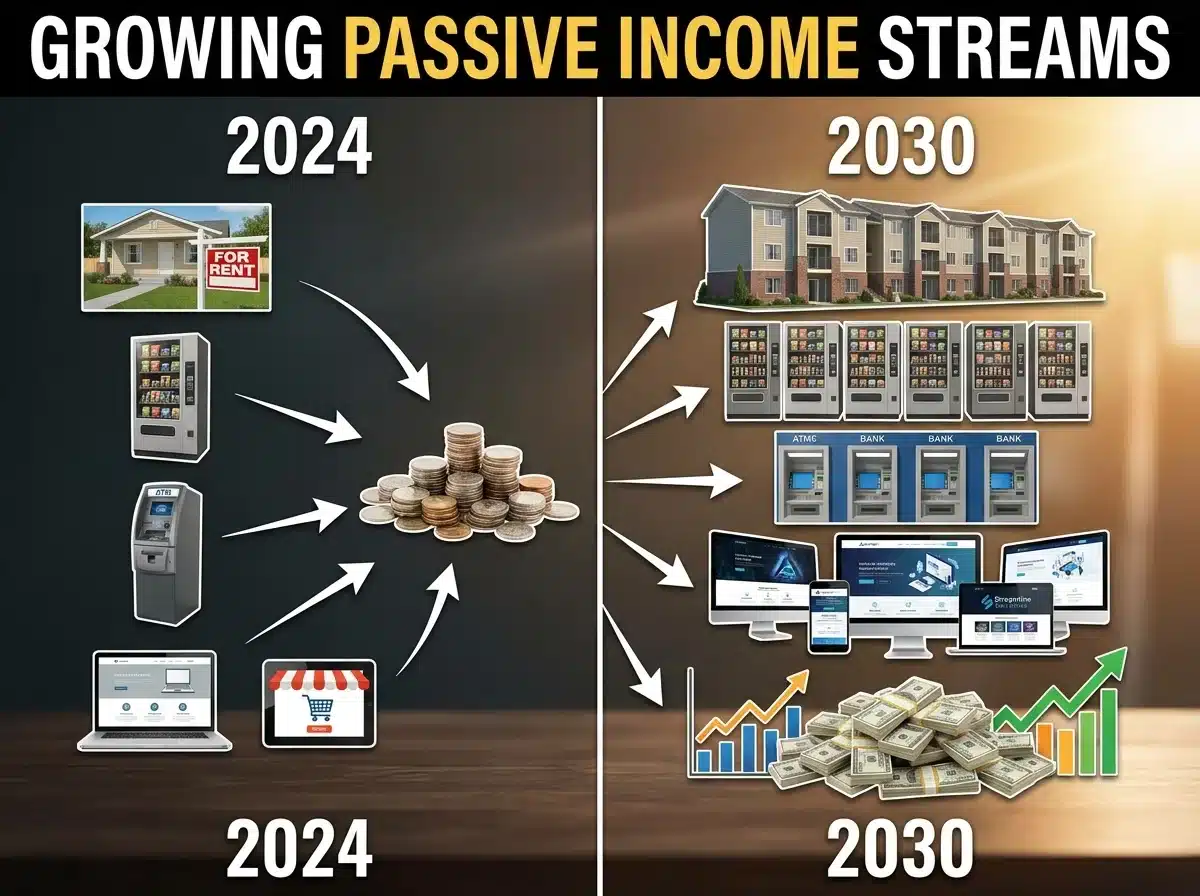
A portfolio of 10–15 machines in strong locations — office buildings, gyms, apartment complexes, universities, hospitals — can generate $100,000+/year. The business is largely operational once machines are placed.
The hardest part is location acquisition. You are negotiating with property managers, building owners, and facility directors — which is a direct sales skill most people do not account for when they imagine this business as passive.
Biggest risk: Bad locations. A machine in the wrong spot earns $50/month and costs you restocking time.
Location quality is the only variable that truly determines whether this business reaches six figures.
First step this week: Drive around your area and identify 20 high-foot-traffic locations with no vending machines currently visible.
Write down the business name for each. Then call or visit each one and ask who manages facility decisions. This creates a prospecting list — a real business action, not research.
Realistic timeline to six figures: 3–5 years to build a route large enough, assuming reinvestment of early profits into additional machines.
10. ATM Machine Business
Best for: People who want a low-time asset business and are comfortable with upfront capital requirements.

The ATM business is one of the most overlooked asset-based businesses available — with a more realistic ceiling than most passive income concepts.
Each ATM generates revenue through surcharge fees, typically $2–$3 per transaction. A busy ATM in a bar, convenience store, or event venue processes 200–400 transactions per month — generating $500–$1,000/month per machine at a $2.50 average surcharge.
These numbers apply to high-traffic urban and suburban locations. Rural placements or low-foot-traffic businesses generate significantly less. A portfolio of 15–20 well-placed machines can generate $100,000+/year.
Startup costs are real — a new ATM runs $2,000–$8,000 per unit, and you need to negotiate placement agreements that typically share a portion of the surcharge revenue with the host business.
Biggest risk: Vandalism, machine downtime, and poor location selection. An ATM that is out of cash or out of service for even a few days per month loses a disproportionate share of its monthly revenue in a high-traffic location.
First step this week: Visit five cash-heavy local businesses — bars, laundromats, barbershops, event venues — and ask if they currently have ATM service and whether they’d consider hosting a machine in exchange for a monthly commission.
Their answers will tell you more about local market demand than any online research will.
Realistic timeline to six figures: 3–5 years to build a route of 15–20 machines with reinvested revenue.
11. Real Estate Investment
Best for: People with access to capital (or strong credit to access it), patience for a 7–15 year compounding timeline, and comfort with the operational complexity of managing properties or tenants.

Real estate requires more capital than any other business on this list, but it also has one of the strongest long-term track records.
A real estate investor earning six figures might own 10–15 single-family rental properties generating $800–$1,200/month in net cash flow each, or 2–3 multi-family properties with stronger per-door income.
The median U.S. home appreciation rate has averaged 4–5% annually over the past 40 years, meaning equity growth compounds alongside rental income. Results vary significantly by market — rental yields in high-cost cities like San Francisco or New York are often far lower than in mid-tier Midwest or Southeast markets.
The barrier is capital. A conventional investment property typically requires 20–25% down.
Lower-capital entry points exist — house hacking (living in a multi-unit property you own and renting the other units), REITs, or real estate syndications — but each has different liquidity and control trade-offs.
Biggest risk: Overleveraging in the early years. Investors who stretch to buy properties with thin cash flow margins are most exposed when vacancy, repairs, or interest rate changes hit simultaneously.
First step this week: Use BiggerPockets’ free rental property calculator to analyze one property currently listed in your local market. Run the numbers honestly — include vacancy, maintenance, and property management costs even if you plan to self-manage. This exercise builds more real investment intuition than hours of content will.
Realistic timeline to six figures in annual income: 7–15 years of consistent acquisition and reinvestment for most investors starting with modest capital.
Trade Businesses
12. Plumbing Company
Best for: People willing to invest 4–5 years in licensing and trade skill development in exchange for a business with near-zero online competition and recession-resistant demand.
Trade businesses are among the most reliable paths to six figures on this list — and among the least glamorous, which is exactly why the opportunity exists.
A licensed plumber in the United States earns a median of $59,000–$75,000/year as an employee. These figures are specific to the U.S. market — plumbing income varies significantly by country and region based on licensing requirements and labor market conditions.
As a business owner with 2–3 employees and a solid local reputation, $200,000–$400,000/year in revenue can be common in established local markets.
Plumbing has near-zero online competition for local service customers — a basic Google Business profile and 20 five-star reviews will consistently outperform competitors spending thousands on ads.
Biggest risk: Physical demands and liability. Plumbing work involves confined spaces, hazardous materials, and the possibility of significant property damage claims if work is done incorrectly. Business insurance is non-negotiable, not optional.
First step this week: If you are already licensed, set up or optimize your Google Business Profile today and personally reach out to your five most recent satisfied customers asking for a Google review. If you are not licensed, contact your state licensing board this week and download the apprenticeship requirements. Knowing the exact path is the first commitment.
Realistic timeline to six figures in revenue: 1–3 years after licensing, for owners who treat marketing and customer reviews as seriously as the trade itself.
13. Electrician
Best for: People who want a trade business with strong future demand driven by structural shifts in energy infrastructure — solar, EV charging, and smart home installation are all growing faster than the supply of licensed electricians.
The setup here mirrors the plumbing entry in terms of licensing requirements, but the future demand curve is arguably steeper.
Licensed electricians in commercial and industrial settings regularly earn $80,000–$120,000 as employees — figures that apply primarily to the U.S. and Canada, with significant variation by region and union status.
As a business owner, electrical contractors with crews of 3–5 clear $300,000–$600,000 in annual revenue. The path requires a formal apprenticeship (typically 4–5 years) or trade school.
The licensing barrier creates a moat. That moat protects the business from many of the competitive pressures facing online-first businesses.
Biggest risk: Physical danger and liability exposure are higher in electrical work than in most businesses on this list.
A single serious error can result in property damage, injury, or permanent license revocation.
Continuing education and strict safety protocol adherence are not optional costs — they are the business.
First step this week: Contact your state’s electrical licensing board and download the full requirements document. Look up the nearest union apprenticeship program — IBEW apprenticeships pay you while you train, which changes the financial calculus entirely for people who cannot afford to go without income during education.
Realistic timeline to six figures: 3–6 years including training, moving faster with a business mindset from day one.
Sell on Amazon and Dropshipping

14. Sell on Amazon
Best for: People with startup capital of $5,000–$15,000, comfort with inventory risk, and patience for an operational business that involves product research, logistics, and customer service — not just selling.
Amazon FBA (Fulfillment by Amazon) lets you sell physical products using Amazon’s warehouse and shipping infrastructure.
You source a product, send inventory to an Amazon warehouse, and Amazon handles storage, packing, and shipping.
Revenue is impressive, but margins determine whether the business actually reaches six figures. Sellers generating $100,000–$500,000/year in revenue are well-documented in the FBA seller community.
Profit margins after Amazon fees and product costs typically run 20–35%, meaning a seller doing $400,000 in revenue might clear $80,000–$140,000 in profit.
These margins assume competitive but not commoditized product categories — heavily saturated niches see margins compressed well below 20%.
Biggest risk: Inventory risk. You pay for inventory before you know it will sell. A poor product selection decision can result in thousands of dollars of unsellable stock sitting in an Amazon warehouse generating monthly storage fees.
First step this week: Use Jungle Scout’s free sales estimator to identify a product in your target category with 300+ monthly sales and fewer than 100 reviews on the top three listings. That combination indicates proven demand without dominant competition. This is validation — not a commitment to buy inventory.
Realistic timeline to six figures in revenue: 1–2 years with strong product selection. Profit depends heavily on margin management and reinvestment decisions.
15. Dropshipping
Best for: People who want to test product-market fit with minimal upfront inventory risk and understand that this is a customer service and marketing business — not a hands-off income model.
Dropshipping has a reputation problem — mostly because people enter it expecting passive income and discover a customer service business instead.
The model works like this — you list products in your online store, customers purchase from you, and your supplier ships directly to them.
Your margin is the difference between your retail price and the supplier’s price.
Successful dropshipping stores in focused niches earn $8,000–$25,000/month. These figures reflect stores with established ad spend, optimized conversion rates, and reliable supplier relationships — not stores in their first 90 days.
The average new store takes 6–12 months to reach consistent profitability, and many do not. The businesses that scale are the ones treating their store as a real brand — not a product arbitrage experiment.
Biggest risk: Thin margins compressed further by rising ad costs. As Facebook and Google advertising costs have increased, the product margins that made dropshipping profitable in 2017 are often insufficient today.
Stores that survive this pressure have either found supplier relationships outside Alibaba or built organic traffic channels alongside paid ads.
First step this week: Go to AutoDS or Spocket and identify one product category with consistent search demand and limited Amazon presence. Then order the product yourself before listing it. Knowing how your supplier’s packaging, shipping speed, and product quality actually perform is information you need before your first customer does.
Realistic timeline to six figures: 1–3 years with a focused niche, strong creative assets for advertising, and disciplined margin management.
Which One Is Right For You?
Fifteen options is a lot to hold in your head. Here is how to narrow it.
- If you have strong professional expertise and want income within 90 days — start with consulting or freelance writing. Both can generate revenue before you finish building a website.
- If you want to build an asset that compounds while you sleep — blogging, affiliate marketing, and YouTube are the right category. Accept the 2–4 year runway they require and treat it as an investment, not a job.
- If you have $5,000–$25,000 in startup capital and want a physical business — vending machines, ATM machines, Amazon FBA, and real estate all have documented paths at that entry point. Each trades capital for time leverage.
- If you are willing to invest 4–6 years in trade licensing — plumbing and electrical businesses offer six-figure income with structural protection from the kind of online disruption that threatens most of the other categories on this list.
- If you want the highest possible upside with the most variables — app development, dropshipping, and courses all have uncapped ceilings but require either technical skill, marketing ability, or an existing audience to get there.
The goal isn’t finding the perfect business. It’s choosing a viable business and staying with it long enough for compounding advantages to appear.
Pick one viable path. Commit for twelve months. Let compounding do the work most people never stick around to see.
Not sure which path fits your situation? Our guide on how to pick a side hustle walks through the exact filters worth using before committing time and money to any of the options above.